Machine jammed mid-stick? Do this first: stop pressing the button, and unplug it. Right now, before reading further. A motor forcing a blockage is how feed gears strip and warranties die — every other part of a jam is fixable in ten minutes with a $3 brush. That is the whole emergency protocol: power off, unplug, then clear calmly.
Now the good news: jams are almost never a broken machine. Nine times out of ten it is packed tobacco dust, a stem wedged in the feed slot, or damp tobacco matted in the channel — all clearable at the kitchen table with no tools beyond a brush and a pipe cleaner. This guide walks the universal 6-step clearing procedure, the electric-vs-manual differences, a jam-type table that tells you exactly where to look, and the three signs it is a worn part rather than a blockage. By the end, jams stop being emergencies and become 10-minute chores. 👉
- The 10-second emergency protocol
- Why machines jam (know your enemy)
- The universal 6-step clearing procedure
- Electric machines: extra rules
- Manual injectors: extra rules
- Jam-type table: where to look by symptom
- When it is NOT a jam: the 3 part-failure signs
- The post-jam restart checklist
- Never again: prevention in 30 seconds a day
- Common mistakes (and fixes)
- Pro tips
- Real-world experiences
- FAQ
- The clearing checklist
The 10-second emergency protocol
- Release the button or crank immediately. Continued force is the only way a jam causes permanent damage.
- Unplug electric machines. Not power-off — unplug. Fingers and feed mechanisms only meet safely when the motor cannot possibly move.
- Leave the half-filled tube where it is for now. Yanking it can tear paper into the nozzle and turn one jam into two.
Why machines jam (know your enemy)
Four causes account for essentially every jam, in this order of likelihood:
- 🧲 Debris buildup (the big one). Tobacco dust and sticky resin narrow the feed slot session by session until the spoon cannot complete its stroke. This is a maintenance debt coming due — the maintenance guide explains the whole economy.
- 🌿 Stems and chunks. A single woody stem wedges across the channel and holds everything behind it. Ten seconds of de-stemming on the tray prevents it.
- 💧 Wrong moisture. Damp tobacco mats into felt and plugs the channel; bone-dry tobacco packs into concrete dust in corners. The springback test in our storage guide catches both.
- 📏 Mismatched tube or setting. Wrong length setting or an unsupported tube size makes the machine fight geometry it cannot win — the format guide covers the trap.
The universal 6-step clearing procedure
Works on every injector, electric or manual. Total time: about ten minutes.
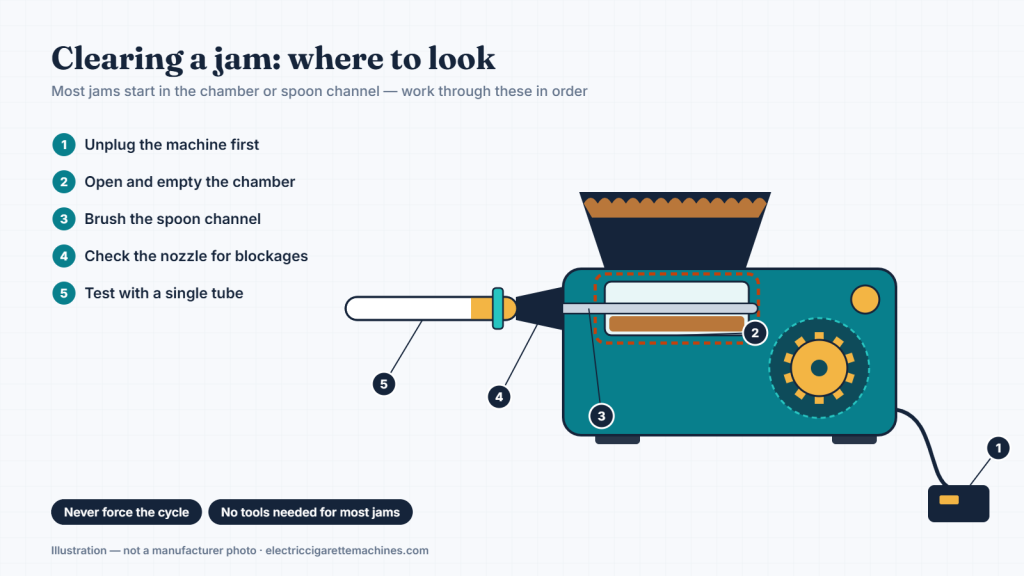
- Power off and unplug (already done if you followed the protocol). Manuals: just set it down.
- Remove the tube and empty the hopper. Gently twist the stuck tube off the nozzle. Pour unused tobacco back into its jar — do not clear a jam through a full hopper.
- Retract the mechanism. Most machines reverse: electrics often free the spoon when powered off (some have a manual return); manual injectors crank backward. Check the manual’s jam section — this is the step where model-specific instructions matter most.
- Invert and tap. Over the tray, tip the machine and tap the body with your palm — twice, firmly. Loose plug material falls out and shows you what you were fighting (stem? clump? dust?).
- Brush the channel end to end. Bristle brush through the feed slot and spoon path, all four directions, until it glides. Pipe cleaner through the nozzle. This is 80% of the fix — see the kit below.
- Air-dust and dry-cycle. Short bursts of compressed air chase the fines out. Then run one empty cycle (no tobacco, no tube). Smooth and quiet = cleared. Grinding or hesitation = repeat step 5, or see the part-failure signs.
🧹 The jam-clearing kit (under $15)
Three tools clear 95% of jams without touching a screwdriver.
| Bristle brush kit | The primary clearing tool — feed slot, spoon channel, nozzle |
|---|---|
| Pipe cleaners | Reach inside the spout and tight corners |
| Compressed-air duster | Blasts fines out after the physical clear |
- ✅ Cleaning brush kit on Amazon ›
- ✅ Bristle pipe cleaners on Amazon ›
- ✅ Compressed-air duster on Amazon ›
See a cleaning brush kit on Amazon ›
As an Amazon Associate we may earn from qualifying purchases.
Electric machines: extra rules
- Respect the thermal cutoff. Many electrics stop mid-cycle to protect the motor after repeated strain. That is a feature: unplug, clear, and give it ten minutes to cool before the test cycle.
- Never bypass or hold switches to force a cycle against resistance.
- Keep liquids and blades out. No solvents in the channel, no knives scraping — plastic guides scar, and scars snag future loads. Brush and air only.
- Listen on the test cycle. A healthy motor sounds even. A laboring whine after a full clean points to drive trouble — manufacturer service territory, not DIY.
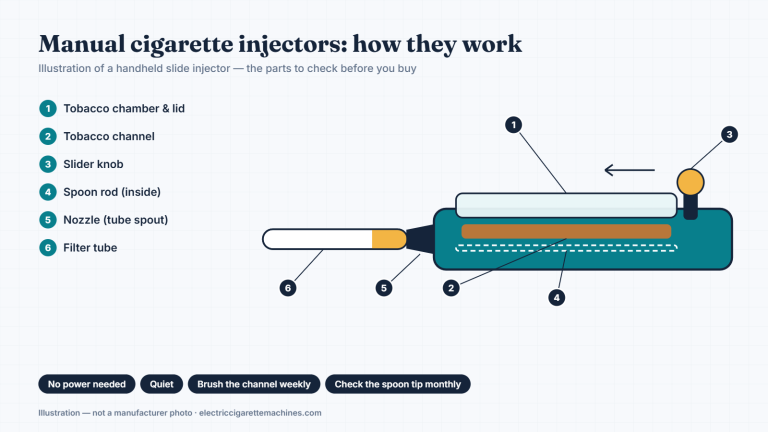
Manual injectors: extra rules
- Back-crank gently. Reverse pressure frees most manual jams instantly. If reverse also resists, stop — something solid is wedged; find it with light and a pipe cleaner, never with force.
- Check the rail alignment. Manual sliders that jam repeatedly are often riding a misaligned or dirty rail; wipe dry-clean and re-seat.
- Mind your hand position. Clearing with one hand while cranking with the other is how fingers get pinched. Clear, then crank.
Jam-type table: where to look by symptom
| What happened | Most likely culprit | Where to clear |
|---|---|---|
| Stopped mid-stroke, tube half-filled | Debris narrowing the channel | Feed slot + spoon path (steps 4–5) |
| Stopped instantly with a click/crunch | Stem or hard chunk wedged | Invert and tap; extract with pipe cleaner |
| Gradual slowdown over several sticks | Damp tobacco matting | Full clear + fix moisture before reloading |
| Jams only on batch stick 15+ | Heat + accumulating fines | Clear; add a mid-batch cool-down and brush |
| Tube blows off instead of filling | Blocked nozzle backpressure | Pipe cleaner through the spout |
| Jams immediately after a deep clean | Tobacco prep, not the machine | The cut & moisture guide |
Prefer an interactive walkthrough? The jam troubleshooting tool asks your symptoms and points to likely causes with a clickable machine diagram.
When it is NOT a jam: the 3 part-failure signs
If jams keep returning within days of a proper clear, stop clearing and start inspecting:
- Rounded or scored spoon edges. Under good light, a healthy spoon has crisp edges. Rounded, shiny, or grooved = it smears tobacco instead of pushing it — replacement time.
- Spoon wobble. Any side-to-side play in the track lets tobacco slip past and accumulate. Wobble is wear, not dirt.
- Cracked tube-mount collar. A hairline crack changes nozzle geometry enough to cause chronic tip jams. Inspect while the tube is off.
🔧 When it is the spoon, not the jam
A worn spoon causes repeat jams no amount of cleaning fixes. Match the part to your exact model number.
- ✅ Rounded edges or scoring on the spoon = replacement time
- ✅ Typical spoon life: 6–18 months of regular use
- ✅ Fitment guide in our replacement parts page
Find replacement parts on Amazon ›
As an Amazon Associate we may earn from qualifying purchases.
The post-jam restart checklist
- ☐ Empty test cycle ran smooth and quiet.
- ☐ Tobacco re-checked: springback test passed, stems out, fluffed.
- ☐ Correct tube size and length setting confirmed.
- ☐ Hopper loaded level, not crammed.
- ☐ First stick treated as calibration — inspect before batching.
- ☐ Jam logged in the maintenance tracker (patterns predict part wear).
Never again: prevention in 30 seconds a day
Every jam guide owes you this paragraph: the machines that never jam are the ones brushed after every session. Tip over the tray, tap twice, brush the feed slot — thirty seconds. Weekly, run the 10-minute standard clean; monthly, the deep clean with spoon inspection. The full schedule by usage level lives in the maintenance guide, and the cleaning planner will build your personal cadence in four questions. Jams are not a machine personality trait — they are deferred cleaning, collected with interest.
Common mistakes (and fixes)
- ❌ Pressing the button again. And again. ✅ The #1 machine-killer. Resistance means stop, not retry.
- ❌ Digging with knives, screwdrivers, or scissors. ✅ Metal scars the channel and creates permanent snag points. Brush, pipe cleaner, air — nothing harder than bristle.
- ❌ Clearing a plugged-in electric. ✅ Unplug. Every time. No exceptions for “quick ones.”
- ❌ Clearing through a full hopper. ✅ Empty it first — working blind under tobacco is how stems get missed.
- ❌ Blaming the machine for prep problems. ✅ If it jams right after a proper clean, audit the tobacco (moisture, stems, cut) before the hardware.
- ❌ Ignoring the pattern. ✅ Same jam, same spot, every week = worn part or wrong supplies, not bad luck. Log it and diagnose.
Pro tips 💡
Real-world experiences
- The button presser: jammed on a Sunday, pressed through the resistance “maybe six times,” and turned a $0 fix into a stripped gear and a new machine. The cautionary tale of the entire category — protocol first.
- The stem detective: chronic weekly jams, two deep cleans, endless frustration — until a flashlight revealed a half-inch stem lodged beside the spoon track. Ten seconds with a pipe cleaner ended a month of trouble.
- The pattern reader: logged three jams in ten days after a year of smooth running, checked the spoon, found rounded edges, swapped it for $9 — zero jams since. The tracker paying rent.
FAQ
How do I fix a jammed cigarette rolling machine?
Unplug, empty the hopper, retract the mechanism per your manual, invert and tap, brush the feed channel end to end, air-dust, then run an empty test cycle. Ten minutes, no tools harder than a bristle brush.
Why does my machine keep jamming after I clean it?
Recurring jams after proper cleaning point to tobacco prep (moisture, stems, cut width), a mismatched tube size or length setting, or a worn spoon. Work that order — the jam tool walks it interactively.
Can I use WD-40 or oil to fix a jam?
No. Lubricants mix with tobacco dust into paste, contaminate the tobacco path, and make everything worse. Machines are designed to run dry unless the manual names a specific food-safe lubricant.
My electric machine stopped and will not restart — is it broken?
Probably the thermal cutoff protecting the motor. Unplug, clear the jam, wait ten minutes, then test. If it still labors after a full clear and cool-down, that is service territory.
How do I get a stuck tube off the nozzle?
Gentle twist while supporting the tube at its base — never a straight yank, which tears paper into the spout. If paper does tear inside, a pipe cleaner extracts the shreds.
How often should I clean to prevent jams?
Thirty seconds of brushing after every session, a 10-minute standard clean weekly for daily rollers, and a monthly deep clean. Full schedule in the maintenance guide.
The clearing checklist ✅
- ☐ STOP pressing. Unplug.
- ☐ Tube off (gentle twist), hopper emptied.
- ☐ Mechanism retracted per the manual.
- ☐ Invert, tap, identify what came out.
- ☐ Brush channel + pipe-clean nozzle until gliding.
- ☐ Air-dust; empty test cycle — smooth = cleared.
- ☐ Repeat jams? Inspect spoon, collar, and tobacco prep.
- ☐ Log it; brush after every session from now on.