Want to quit smoking — and want to know what actually works? Here it is, compressed: medication plus support beats willpower alone, by a lot. Cold turkey succeeds for roughly 3–5% of attempts. Nicotine replacement (patches, gum, lozenges) roughly doubles those odds; combining a patch with a short-acting form does better still; prescription options can outperform both; and adding real support — a quitline, a program, even structured texts — multiplies whichever route you choose. None of this requires perfection: most successful quitters needed several attempts before the one that stuck.
Yes, this is a website about rolling equipment telling you how to stop needing it. We have said in every guide that quitting beats any gear we review — this page is that sentence, kept properly. Below: the evidence-ranked methods, how to actually use NRT (most people under-dose it), the prescription conversation worth having, a quit-day plan, the relapse math that reframes “failure,” and the timeline of what your body does the moment you stop. This is general information, not medical advice — your doctor or pharmacist personalizes it, especially if you are pregnant or managing health conditions. 👉
- The methods, ranked by evidence
- NRT done right (most people under-dose)
- The prescription conversation
- Support: the multiplier
- The vaping question, answered honestly
- The quit-day plan
- Slips, relapses, and the real math
- What your body does when you stop
- Common mistakes (and fixes)
- Pro tips
- Real-world experiences
- FAQ
- The quit checklist
The methods, ranked by evidence
| Method | Evidence verdict | Notes |
|---|---|---|
| Prescription medication (varenicline; bupropion) | ✅✅ Strongest single aids | Varenicline is the most effective single medication in trials; generic available |
| Combination NRT (patch + gum/lozenge) | ✅✅ Comparable to prescriptions | Steady base + craving rescue — the OTC gold standard |
| Single-form NRT | ✅ Roughly doubles unaided odds | Works better used fully and long enough |
| Counseling / quitlines / programs | ✅ Independent benefit; multiplies medication | 1-800-QUIT-NOW is free in every U.S. state |
| Cold turkey alone | 🟡 ~3–5% per attempt | Works eventually for some — usually across many attempts |
| Tapering cigarettes without aids | 🟡 Weak alone | Better as a ramp INTO a medicated quit date |
| “Miracle” methods (lasers, detox kits, hypnosis-as-cure) | ❌ No reliable evidence | Money toward proven tools instead |
The sentence to keep: medication handles the withdrawal; support handles the habit; the plan handles the moments. Stack all three and you are quitting the way the success statistics were made.
NRT done right (most people under-dose)
Nicotine replacement gives your brain a controlled, spike-free dose while you dismantle the habit — no smoke, no tar, designed for tapering. The three OTC forms:
- Patch — the steady base. Step-down strengths (commonly 21→14→7mg); heavier smokers start higher. One each morning, rotate skin sites.
- Gum — craving rescue. The technique everyone gets wrong: chew until peppery, then PARK it against the gum; chew-park-repeat ~30 minutes. Continuous chewing wastes the dose into your stomach.
- Lozenge — rescue without technique; dissolve, do not chew or swallow it.
The three failure patterns, and their fixes: under-dosing (a pack-a-day smoker on 2mg gum alone is bringing a squirt gun — use the patch base + rescue form); quitting NRT too early (run the full 8–12 week program; stopping at week two is the classic relapse setup); and fearing the nicotine (NRT’s slow delivery is far less addictive than smoking — the danger you know is the cigarette).
💊 The OTC quit kit
FDA-approved cessation aids — the one nicotine category Amazon sells, and often covered by insurance/FSA at the pharmacy counter too:
| Base | Step-down nicotine patches |
|---|---|
| Rescue | 4mg gum or lozenges (2mg for lighter smokers) |
| Support | 1-800-QUIT-NOW (free) + your pharmacist |
As an Amazon Associate we may earn from qualifying purchases. Check dosing against the package and your pharmacist’s advice.
The prescription conversation
One short appointment (or telehealth visit) unlocks the strongest tools:
- Varenicline — blocks nicotine’s reward at the receptor while easing withdrawal; the most effective single medication in head-to-head trials, now generic. Typically started a week before quit day.
- Bupropion — an antidepressant that independently reduces cravings; useful alone or combined, and helpful for smokers also watching mood or weight.
- Combinations and coverage: clinicians routinely pair medication with NRT, and most U.S. insurance (and many state programs) cover cessation medication — often free. Say the sentence “I want to quit smoking” and the system largely mobilizes for you.
Both medications have side-effect and suitability considerations — that is exactly what the prescriber conversation is for. This page’s job is only to make sure you know the strongest shelf exists.
Support: the multiplier
- 1-800-QUIT-NOW — free coaching in every state, often with free NRT starter kits. The single highest-value phone call in this space.
- Text programs and apps (SmokefreeTXT and similar) — structured nudges that measurably improve success, for zero effort.
- Your pharmacist — dosing, combinations, coverage, on demand, no appointment.
- Telling people — accountability is unglamorous and effective; so is asking your household to keep smoking outside your space during the first weeks.
The vaping question, answered honestly
Asked constantly, so answered plainly: no vaping product is FDA-approved for smoking cessation, and this site does not recommend starting one to quit. The honest full picture: some clinical trials have found e-cigarettes can outperform NRT at achieving switching — but switchers usually remain nicotine-dependent on the new product, which is why health authorities steer quitters to approved tools first. If you already vape as your off-ramp, the goal worth writing down is the same taper-to-zero the JUUL guide maps out. Start with the proven ladder; treat vaping as a fallback conversation with your doctor, not step one.
The quit-day plan
- Pick a quit date within two weeks — soon enough to be real, far enough to prepare.
- Assemble the stack before the date: medication or NRT purchased, quitline saved, app installed.
- Map your triggers — coffee, driving, after meals, stress, alcohol — and write a specific substitute for each (lozenge, walk, water, the deep-clean project below).
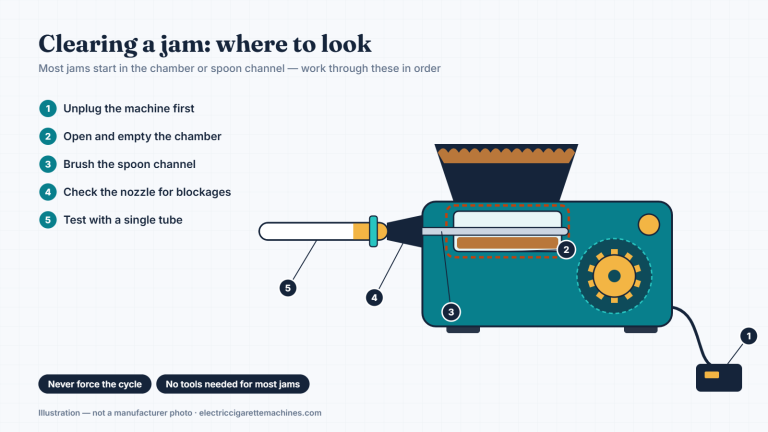
- Clear the environment the night before: cigarettes, lighters, ashtrays — and if you roll, the machine and supplies too. Give the gear to a smoking friend or box it out of reach; an injector on the counter is a trigger with a handle.
- Deep-clean for the fresh-start effect: our smell-removal guide doubles as relapse prevention — a home that no longer smells like smoking argues for you all day.
- Plan the first 72 hours hour-by-hour — the withdrawal peak. Busy hands, full water bottle, rescue doses in every pocket.
- Do the money math from our cost guide in reverse: even RYO’s “cheap” sticks fund a vacation when they stop entirely. Automate that transfer weekly.
Slips, relapses, and the real math
Most people who successfully quit needed multiple attempts — commonly many. That is not a character verdict; it is how learning a hard skill looks. The operational rules: a slip (one cigarette) is data, not doom — note the trigger, adjust the plan, continue the same day without the “ruined it, might as well” spiral. A full relapse means the next attempt starts with better intelligence: what worked, what broke, which tool was missing. Each serious, tool-supported attempt has meaningfully better odds than the last one’s memory suggests. The only failed quit is the one not re-attempted.
What your body does when you stop
| Time since last cigarette | What happens |
|---|---|
| 20 minutes | Heart rate and blood pressure begin dropping |
| 12 hours | Carbon monoxide in blood falls to normal |
| 2 weeks – 3 months | Circulation improves; lung function increases |
| 1–9 months | Coughing and breathlessness decrease; lung cilia recover |
| 1 year | Excess heart-disease risk roughly halves |
| 5–15 years | Stroke risk approaches a non-smoker’s |
| 10 years | Lung cancer death risk roughly half a continuing smoker’s |
| 15 years | Heart-disease risk near a non-smoker’s |
The timeline’s quiet message: the body starts repaying the decision within the hour, and never stops. There is no age or pack-year count at which quitting stops being worth it.
Common mistakes (and fixes)
- ❌ White-knuckling because “aids are cheating.” ✅ The 3–5% method. Tools exist because withdrawal is pharmacological; use them.
- ❌ Under-dosing NRT. ✅ Patch base + rescue form, full program length. Ask the pharmacist to sanity-check your dose against your habit.
- ❌ Keeping “emergency” cigarettes (or the rolling setup on the counter). ✅ Clear it all. Distance is a tool.
- ❌ Quitting during a crisis week by choice. ✅ Pick a date with normal stress; protect the first 72 hours.
- ❌ Treating a slip as proof of failure. ✅ Same-day continuation, trigger noted, plan patched.
- ❌ Swapping to “lighter” smoking as the plan. ✅ The filters guide covers why that road goes nowhere.
Pro tips 💡
Real-world experiences
- The seventh attempt: six unaided failures across a decade; attempt seven used patches + lozenges + the quitline and held. “Nothing about me changed except the toolkit.” The statistics, personified.
- The pharmacist assist: a half-pack smoker under-dosing 2mg gum alone, re-do’d in a five-minute counter conversation to patch + 4mg rescue. Cravings “dropped from constant to occasional” within days.
- The gear boxer: an RYO roller who boxed the injector, tubes, and jars into the garage on quit day — “the counter stopped asking.” Sold the setup at 90 days as the celebration.
FAQ
What is the most effective way to quit smoking?
Medication (prescription varenicline, or combination NRT) plus behavioral support — the stacked approach several-fold outperforms willpower alone.
Does cold turkey work?
For roughly 3–5% per attempt. People do succeed that way — usually across many tries. The tools exist to shorten that road.
How should I use nicotine gum correctly?
Chew until peppery, then park it between cheek and gum; repeat for about 30 minutes. Continuous chewing swallows the dose and causes hiccups instead of relief.
Is vaping a good way to quit?
No vape is FDA-approved for cessation, and switchers typically stay nicotine-dependent. Start with approved tools; discuss vaping as a fallback with your doctor if those fail.
How long until my body recovers?
Benefits start in 20 minutes, carbon monoxide normalizes in 12 hours, heart risk roughly halves at one year, and risks keep falling for 15+ years. It is never too late to gain from quitting.
What if I relapse?
Join the majority of eventual successes — analyze the trigger, upgrade the toolkit, set the next date. Attempts are practice, and each supported one carries better odds.
The quit checklist ✅
- ☐ Quit date set, within two weeks.
- ☐ 1-800-QUIT-NOW called; app or text program enrolled.
- ☐ Medication or patch+rescue NRT purchased; dosing pharmacist-checked.
- ☐ Triggers mapped with written substitutes.
- ☐ Cigarettes, lighters, ashtrays — and rolling gear — out of the house.
- ☐ Home deep-cleaned; savings auto-transfer scheduled.
- ☐ First 72 hours planned hour-by-hour; 2am note written.
- ☐ Slip protocol agreed with yourself in advance: note, adjust, continue.