Are cigarette rolling machines actually worth it? Honest answer up front: for a daily smoker, almost always yes — the math is overwhelming. A pack-a-day habit typically costs $2,900–$5,500 a year at the register; the same volume rolled at home usually lands between $750–$1,300 including equipment. The machine pays for itself in two to five weeks. But “worth it” is not only math: rolling costs you time (about 20 minutes a week once practiced), a small learning curve, and a maintenance habit. For light smokers, the case gets genuinely weaker.
This guide runs the honest evaluation most sales pages skip: real savings by consumption level, the break-even timeline, the time cost nobody mentions, who should NOT bother, and the non-money benefits and drawbacks that decide whether the habit sticks. By the end you will know your answer with numbers, not vibes. 👉
The core math, honestly
Three numbers decide everything. Pack prices vary hugely by state, so run your own figures in our cost calculator — these are representative ranges:
| Item | Store-bought | Roll your own |
|---|---|---|
| Per cigarette | 40–75¢ | 10–18¢ |
| Per pack-equivalent (20) | $8–15 | $2–3.60 |
| Pack-a-day, yearly | $2,900–$5,500 | $750–$1,300 |
| Equipment, year one | $0 | $40–160 (machine + accessories) |
Where the RYO number comes from: pipe-cut tobacco at typical prices contributes roughly 8–15¢ per stick, tubes about 1–2¢ (see the tubes guide for the per-tube math), and equipment amortizes to pennies within months. The savings rate lands between 50% and 75% for most people, highest in high-tax states. That range has held for years because the tax gap between packaged cigarettes and loose tobacco — explained in our tobacco guide — is structural, not a sale.
Break-even by consumption level
Assuming a $60 beginner electric injector plus $40 of accessories, and mid-range prices:
| Smoking level | Weekly savings | Equipment break-even | Year-one net savings | Verdict |
|---|---|---|---|---|
| Pack-a-day+ | $40–80 | 2–3 weeks | $2,000–$4,200 | ✅ Overwhelming |
| Half-pack daily | $20–40 | 3–5 weeks | $950–$2,000 | ✅ Clear yes |
| Few per day | $8–18 | 6–12 weeks | $300–$800 | 🟡 Worth it, modestly |
| Social / weekend only | $3–8 | 3–8 months | $50–$250 | 🟡 Marginal — see below |
Two honest notes on that table. First, heavy smokers save the most — which is an uncomfortable sentence to type on a site that tells you plainly that smoking is harmful; cheaper cigarettes are not a health win, and if quitting is on your mind, 1-800-QUIT-NOW beats every row of this table. Second, light smokers can improve their math with a $10 manual injector instead of an electric — the manual route drops equipment cost to almost nothing.
The time cost nobody mentions
Rolling is a chore, and pretending otherwise is how people quit RYO in week two. The honest time budget, once past the learning curve:
- Batch rolling: a carton-equivalent (200 sticks) takes 45–75 minutes on a beginner electric, faster on heavy-duty machines. Pack-a-day = roughly 20 minutes per week of actual rolling.
- Prep and cleanup: 5 minutes per session with a tray and the 30-second brush habit from the maintenance guide.
- The learning curve: the first week produces some ugly sticks while you dial moisture and density — our first-time setup guide compresses this to days.
Price that time however you like: at even $25/hour, pack-a-day rolling “costs” about $9 a week in labor against $40–80 saved. The math survives. What kills the habit is not time on paper — it is running out of sticks on a Tuesday night because batching never became routine. Weekly batch day, calendar reminder, done.
The non-money benefits
- 🎛️ Control. You pick the tobacco blend, the tube (filtered king or 100mm — see the format guide), and the fill density. No reformulations, no surprises.
- 📦 Supply independence. A stocked jar and a box of tubes end the 11pm gas-station run entirely.
- 💰 Spending visibility. Buying tobacco by the bag makes weekly consumption visible in a way packs never do — several readers report smoking less once the amount became tangible.
- 🛠️ The ritual. Some people genuinely enjoy the batch session — same appeal as home coffee roasting. If that is you, the “time cost” flips to a benefit.
The honest drawbacks
- It is a chore that never fully disappears. Batch day skipped twice = back at the register.
- Maintenance is mandatory. Machines jam when neglected — the jam guide exists for a reason.
- Upfront learning. Moisture, density, cut — a week of imperfect sticks.
- Storage discipline. Tobacco dries out without the jar-and-humidity-pack setup.
- ⚠️ The consumption trap. Cheap sticks tempt some people into smoking more, which erases savings and worsens the only cost that matters. Count your sticks.
Who should NOT bother
- Anyone planning to quit soon. Do not invest in equipment for a habit you are ending — put the machine money toward NRT and keep the quit date.
- True occasional smokers (a few per week). Break-even takes most of a year; a manual injector or nothing at all is the rational call.
- People who know they will not maintain gear. If the 30-second brush habit is honestly never going to happen, the machine will disappoint you.
- Anyone hoping RYO is healthier. It is not — same smoke, same risks. If that was the draw, close this tab and call 1-800-QUIT-NOW instead; it is free and it works.
The verdict matrix
| You are… | Worth it? | Setup to buy |
|---|---|---|
| Pack-a-day, staying a smoker | ✅ Emphatically | Heavy-duty electric + carton tubes |
| Half-pack daily | ✅ Yes | Beginner electric + 200-box tubes |
| Few per day, budget-minded | 🟡 Yes, modestly | Beginner electric or manual injector |
| Weekend social smoker | 🟡 Only if you enjoy the ritual | $10 manual injector |
| Quitting soon | ❌ No | NRT + a quit date |
If yes: the smart way to start
Total for the proven starter path: about $75–110.
- Machine: beginner-class electric injector (or manual for light use) — the 60-second quiz picks your class.
- Tubes: one 200-box of name-brand king size (picks here).
- Tobacco: a small pouch of medium shag at proper moisture — audition before bulk (guide).
- Support gear: tray, airtight jar, brush kit.
- First session: follow the setup guide; treat week one as tuition.
📦 The complete worth-it starter setup
Everything above, live pricing:
- ✅ Beginner electric injectors: the Powermatic 2 ›
- ✅ King-size tubes: ZEN full flavor ›
- ✅ Rolling trays: the RAW tray ›
- ✅ Cleaning brush kit ›
As an Amazon Associate we may earn from qualifying purchases.
Common mistakes (and fixes)
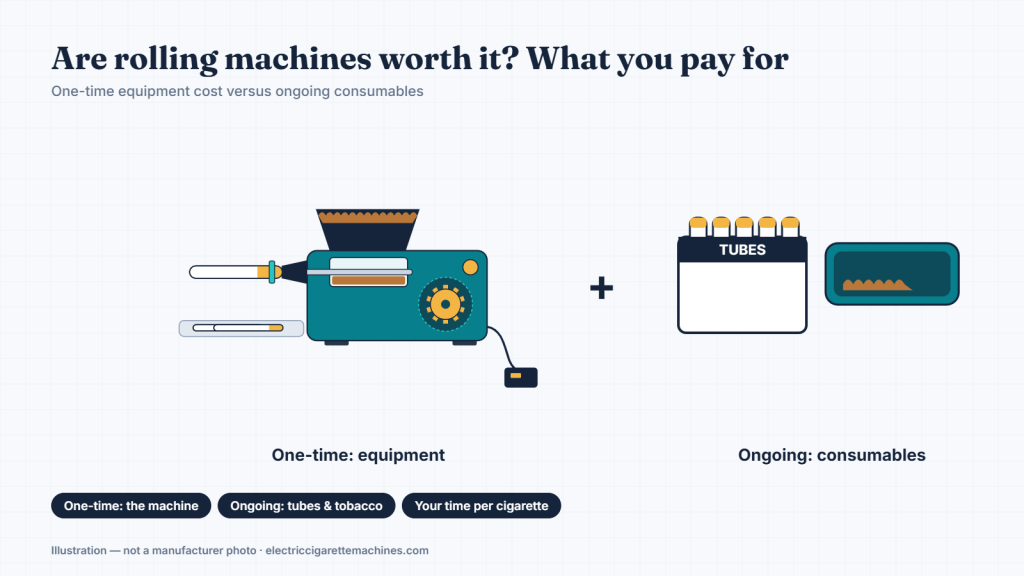
- ❌ Judging worth by the machine price alone. ✅ The machine is the smallest number; consumables and your volume decide everything.
- ❌ Buying premium gear before proving the habit. ✅ Start beginner-class; upgrade with knowledge after a month.
- ❌ Letting cheap sticks raise your count. ✅ Track sticks per week from day one — savings only exist at equal-or-lower consumption.
- ❌ Quitting RYO over week-one ugly sticks. ✅ That is the learning curve, not the verdict — density and moisture fix in days.
- ❌ Skipping storage. ✅ A $10 jar protects a $30 bag; dried tobacco is money composting.
Pro tips 💡
Real-world experiences
- The receipt keeper: pack-a-day smoker who tracked 90 days each way — $1,127 at the store vs $404 rolling his own, machine included. Bought a better machine with the difference and still came out $600 ahead. The classic conversion story.
- The weekend realist: social smoker who did the math honestly, skipped the electric, and keeps a $9 manual injector in a drawer. “Saves me maybe $80 a year and that is fine.” Right-sized is worth it too.
- The cautionary counter: rolled cheap, drifted from 15 to 22 sticks a day, and realized the savings had evaporated into volume. Set a weekly roll limit and recovered both numbers. Count your sticks.
FAQ
Are cigarette rolling machines worth it?
For daily smokers, clearly yes — typical savings run 50–75%, with equipment paying for itself in weeks. For occasional smokers the case is marginal; a cheap manual injector or nothing is often smarter.
How much money do you save rolling your own cigarettes?
Most daily smokers save $1,500–$4,000+ per year depending on state prices and consumption. Run your numbers in the cost calculator.
How long does a rolling machine take to pay for itself?
Two to five weeks for daily smokers; a few months for light smokers. See the break-even table above.
Is rolling your own healthier than buying packs?
No. Same combustion, same risks. RYO is a cost and control decision only — and quitting beats both options.
How much time does rolling your own take?
About 20 minutes weekly for a pack-a-day smoker using an electric injector, after a one-week learning curve.
What does a complete starter setup cost?
$75–110 for machine, tubes, tray, jar, and cleaning kit — covered in the smart-start section above.
Decision checklist ✅
- ☐ Confirm 21+ — and honestly consider quitting first.
- ☐ Count your real weekly consumption.
- ☐ Find your row in the break-even table.
- ☐ Yellow or green verdict? Buy the right-sized setup, not the biggest.
- ☐ Two-carton trial with receipts.
- ☐ Weekly batch day on the calendar; sticks counted.
- ☐ Re-run the math (and the quit question) yearly.