Quick answer: on an electric cigarette injector, the parts that actually wear out are the spoon (injector slide), the nozzle/tube spout, the tube holder clip, and — on heavily used machines — the gears and motor. Most other “repairs” are really cleaning jobs. Before you buy anything, find your machine’s exact model number, compare the old part side by side with the listing, and check whether the problem goes away after a proper clean.
- The parts map: what’s inside your machine
- Which parts wear out (and the warning signs)
- Diagnose by symptom: which part to check first
- How to identify the exact part you need
- Electric vs manual machine parts
- Part-by-part guide
- OEM vs universal vs third-party parts
- Where to buy spare parts safely
- How to fit common parts
- Repair or replace the whole machine?
- Three common repair scenarios
- Make your parts last longer
- Common mistakes (and fixes)
- FAQ
- Spare-parts checklist
The parts map: what’s inside your machine
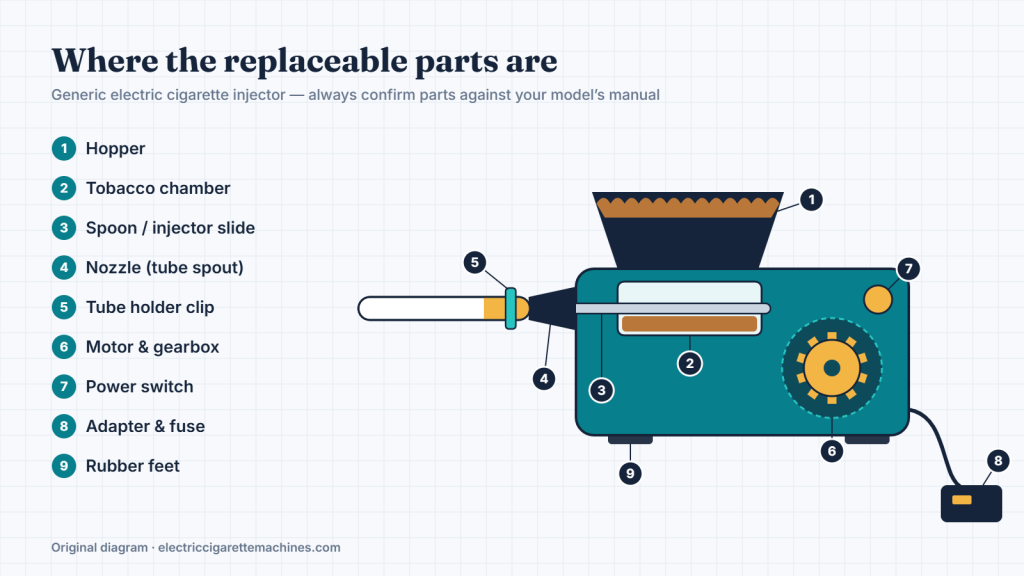
Every electric cigarette injector — whatever the brand — follows the same basic layout: tobacco goes into a hopper, drops into a chamber, gets compressed, and a spoon (also called the injector slide or rod) pushes that compressed log through a nozzle into an empty filter tube held in place by a clip. A small motor drives the spoon through a set of gears. Knowing these names matters, because sellers use them inconsistently — the same part can be listed as a “spoon”, “slider”, “injector rod” or “plunger”.
Which parts wear out (and the warning signs)
Most “broken” machines have one worn part, not a dying motor. This table lists every common replaceable part, what it does, the symptoms that point to it, and how hard it is to change at home.
| Part | What it does | Signs it’s worn or failing | DIY difficulty |
|---|---|---|---|
| Spoon / injector slide | Pushes the tobacco log into the tube | Under-filled or uneven cigarettes, tobacco left in the chamber, visible scoring or a bent tip | Easy on most models |
| Nozzle / tube spout | Guides tobacco into the tube | Torn tubes, tubes that won’t seat, cracks or burrs on the tip | Easy–moderate |
| Tube holder clip | Holds the tube on the nozzle | Tubes slip off mid-cycle, loose fit, cracked plastic | Easy |
| Tobacco chamber / packing area | Compresses tobacco before injection | Inconsistent density, tobacco escaping around seams | Moderate (often not sold separately) |
| Hopper / lid | Holds loose tobacco | Cracks, broken hinges or latches | Easy |
| Gears & motor | Drive the spoon back and forth | Grinding, clicking, motor hums but spoon doesn’t move, burning smell | Hard — often a sign to weigh replacement |
| Power switch | Starts the cycle | Needs several presses, intermittent starts | Moderate (soldering on some models) |
| Power adapter, cord & fuse | Supplies power | No power at all, warm or damaged cord, blown fuse | Easy (adapter) to moderate (fuse) |
| Rubber feet & springs | Stability and return tension | Machine walks on the counter, spoon doesn’t return fully | Easy |
Diagnose by symptom: which part to check first
Start with the symptom you can see, then check parts in this order — cheapest and most likely first. Clean before you replace at every step.
| Symptom | Check first | Then check | Usually a part problem? |
|---|---|---|---|
| Cigarettes loosely or unevenly filled | Tobacco moisture and amount in the chamber | Spoon wear, chamber seams | Sometimes — often tobacco prep |
| Tubes tear or split | Tube quality and size | Nozzle tip burrs or cracks | Often — the nozzle |
| Tubes slip off during the cycle | Tube seated fully on the nozzle | Tube holder clip tension | Often — the clip |
| Machine stops mid-cycle | Overfilled chamber or jam | Spoon alignment, gears | Rarely at first — usually a jam |
| Grinding or clicking noise | Tobacco caught in the mechanism | Stripped gears | If it persists after cleaning — yes |
| Motor hums, spoon doesn’t move | Jam or obstruction | Gears, motor coupling | Often — drive parts |
| No power at all | Wall socket and adapter connection | Adapter output, fuse, switch | Often — adapter or fuse |
| Machine moves across the counter | Surface is clean and dry | Rubber feet | Yes — feet are cheap to replace |
Still stuck? Our interactive jam troubleshooting tool walks you through symptoms step by step.
How to identify the exact part you need
The single most common spare-parts mistake is buying a part that is “for electric cigarette machines” in general. Parts are rarely interchangeable between brands, and sometimes not even between generations of the same brand. Work through these steps before ordering:
- Find the model and version. Look on the underside label, the back panel, the original box or the manual. Write down the full name including any number or “plus/II/III” suffix — these often mark a redesign with different parts.
- Confirm your tube size. King-size and 100 mm machines use different spoons and sometimes different nozzles. If you’re unsure which tubes you run, our king size vs 100mm guide and the tube compatibility checker will settle it.
- Photograph the old part. Take clear photos from two angles next to a ruler. Compare length, width, mounting holes and tip shape against the listing photos — not just the title.
- Check the manual’s parts list. Many manuals include an exploded diagram with part names; use those exact words when you search.
- Ask the seller. A reputable parts seller will confirm compatibility with your model before you buy. If they can’t or won’t, treat that as a warning sign.
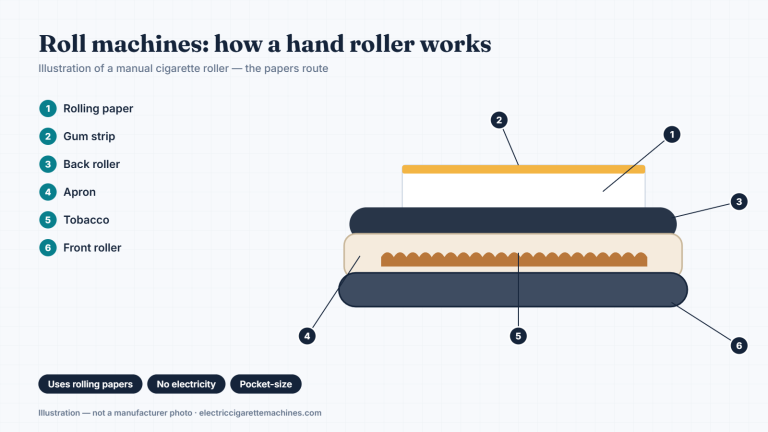
Electric vs manual machine parts
Manual injectors have far fewer parts that can fail, which is one reason some people keep one as a backup. Here’s how the two compare from a spare-parts point of view.
| Electric injector | Manual injector | |
|---|---|---|
| Parts that wear | Spoon, nozzle, clip, gears, motor, switch, adapter | Slide/plunger, nozzle, spring, lever pivot |
| Most common failure | Worn spoon or nozzle; occasionally drive gears | Worn slide or weakened spring |
| Electrical risk | Yes — adapter, cord, switch, motor | None |
| Parts availability | Varies widely by brand and model age | Simpler parts, but often brand-specific too |
| Typical fix at home | Swap spoon/nozzle/clip; replace adapter | Swap slide or spring |
| When replacement wins | Motor or gearbox failure on an older unit | Cracked frame or bent lever |
Comparing machine types before you buy? See our manual injector guide and whether rolling machines are worth it.
Part-by-part guide
Spoon (injector slide)
The spoon does the hardest work in the machine and is the part most owners eventually replace. Wear shows up as scoring along its length, a rounded or bent tip, or a slight sideways wobble. The result is under-filled cigarettes and tobacco left behind in the chamber. Before replacing it, clean it thoroughly — dried tobacco resin can mimic wear by stopping the spoon sliding smoothly. If a clean spoon still fills poorly, replace it with one that matches your tube length.
Nozzle (tube spout)
Tubes are pushed onto the nozzle hundreds of times, so its tip slowly develops burrs or hairline cracks. The tell-tale sign is torn or split tubes even when you’re using the same tube brand as before. Run a fingertip gently around the tip: if it feels rough, that’s your culprit. On some machines the nozzle is part of a larger front assembly, so check whether it’s sold alone.
Tube holder clip
A small, cheap part that causes big frustration when it loosens: tubes slide off mid-cycle and tobacco ends up on the counter. Replacement is usually a simple clip-on or one-screw job.
Gears and motor
Grinding, clicking, or a motor that hums while the spoon doesn’t move usually points to the drive. Sometimes it’s just a jam — follow our jam-clearing guide first. If the noise persists after a clear and clean, the gears may be stripped. Gear and motor replacements involve opening the case and, on some models, soldering; weigh that against the age and value of the machine (see repair or replace).
Power switch, adapter and fuse
If the machine is completely dead, start with the simplest checks: a different wall socket, the adapter’s output, and the fuse if your model has one. A replacement adapter must match the original’s voltage, current rating and plug polarity exactly — these are printed on the original adapter’s label. Never use an adapter that merely “fits the socket”.
Hopper, lid, springs and feet
Cosmetic and structural parts — cracked lids, broken latches, worn rubber feet, tired return springs — are low-risk, easy swaps that keep an otherwise healthy machine stable and clean.
OEM vs universal vs third-party parts
| Option | Pros | Cons | Best for |
|---|---|---|---|
| OEM (original manufacturer) | Designed for your model; fit is predictable | Can be hard to find for older or discontinued machines | Spoons, nozzles, gears — anything precision-critical |
| Model-specific third-party | Often easier to find; may be cheaper | Quality varies; check dimensions and reviews carefully | Clips, springs, feet, lids |
| “Universal” parts | Widely available | Frequent fit problems; vague specifications | Only after measuring and confirming dimensions |
| Used / salvaged parts | Sometimes the only source for discontinued models | Unknown wear; usually no returns | Out-of-production machines |
Where to buy spare parts safely
Where you buy matters almost as much as what you buy. In rough order of preference:
- The manufacturer or its listed distributors. The surest fit, and the best route for spoons, nozzles and drive parts.
- Specialist roll-your-own retailers. Many stock parts for popular machines and can confirm compatibility.
- Large marketplaces such as Amazon. Convenient and easy to return through, but check the model compatibility list, the dimensions and recent reviews that mention your machine.
- Used listings. Sometimes the only option for discontinued models; inspect photos closely and expect no warranty.
Also see our overview of replacement parts by category and cleaning tools.
Questions to ask a parts seller before you buy
- Which exact models and versions is this part confirmed to fit?
- Is it an original manufacturer part or a third-party copy?
- What are its dimensions (length, diameter, mounting points)?
- Is it for king-size or 100 mm tubes — or adjustable?
- What’s the return policy if it doesn’t fit?
A seller who answers these clearly is far more likely to send you the right part the first time.
🔧 Spare-parts starter kit
Parts links open Amazon search results — check every listing against your exact model and dimensions before buying.
| Replacement parts for your model | Spoons, nozzles, clips and springs listed for your machine |
|---|---|
| Cleaning brush kit | Prevents most “worn part” symptoms in the first place |
| Matching power adapter | Only if the voltage, current and polarity match your original |
Browse spare parts on Amazon ›
As an Amazon Associate we may earn from qualifying purchases. Availability and prices change; we don’t list either here.
How to fit common parts
Exact steps differ by model, so treat your manual as the authority. This general sequence works for most spoon, nozzle and clip swaps:
- Unplug the machine and let the motor stop completely.
- Empty and brush out the hopper and chamber so loose tobacco doesn’t fall into the mechanism.
- Photograph everything before removing a single screw — it makes reassembly painless.
- Remove the old part gently. If it resists, look for a hidden screw or clip rather than forcing it.
- Compare old and new side by side before fitting. If they differ, stop and check with the seller.
- Fit the new part, reassemble, and test with a single tube before running a full session.
Repair or replace the whole machine?
Use this quick decision guide:
- Repair when the problem is a spoon, nozzle, clip, spring, lid, feet or adapter. These are usually inexpensive and quick to swap.
- Think carefully when the gears or switch have failed. Price the parts plus your time, and check whether they’re still available for your model.
- Lean towards replacing when the motor has failed on an older or budget machine, parts are discontinued, or the frame itself is cracked. Our Powermatic 2 and Top-O-Matic guides are good starting points if you do replace.
Three common repair scenarios
These illustrative examples show how the steps above fit together. They’re composites of typical situations, not individual reviews.
1. “My cigarettes have gone loose over a few months”
A gradual change points to wear or build-up, not a sudden failure. The owner deep-cleans the chamber and spoon, re-tests with freshly conditioned tobacco, and finds the fill is still weak. Inspecting the spoon shows a rounded tip. They confirm their model and tube length, order the matching spoon, fit it in a few minutes and test one tube. Fill is back to normal.
2. “Every third tube tears”
The owner first tries a new box of tubes from a brand that worked before — the tearing continues. Running a fingertip around the nozzle reveals a small burr. A replacement nozzle (or, on some machines, the front assembly that includes it) fixes the problem. They keep a spare clip at the same time, since it’s the next most likely part to loosen.
3. “It grinds, then stops”
The owner unplugs immediately and clears a jam, but the grinding returns on the next cycle. With the case open, they find chipped gear teeth. Because the machine is several years old and the drive parts are expensive and hard to find, they compare the total cost against a new machine — and decide replacement makes more sense. The old machine’s spoon and clips go into their spares drawer.
Make your parts last longer
Most premature wear comes from dirt and force. Brush out the chamber and spoon after every session, use tobacco with the right moisture and cut (see best tobacco for rolling machines), use good-quality tubes (our tube guide), and never push through a jam. A regular deep clean — covered step by step in our machine maintenance guide — will add a lot of life to every moving part. New to your machine? Start with how to use an electric rolling machine.
Build a small spare-parts kit
If your machine is part of a daily routine, a small kit stops one worn part from halting everything. Keep these in a labelled box with your manual:
| Item | Why keep it | Priority |
|---|---|---|
| Spare spoon (matching your tube length) | The most common wear part | High |
| Spare tube holder clip | Cheap, and a loose clip stops a session | High |
| Cleaning brush and pipe cleaners | Prevents most “worn part” symptoms | High |
| Spare nozzle (if sold separately) | Ends tube tearing quickly | Medium |
| Correctly rated spare fuse (if your model uses one) | Restores power after a blown fuse | Medium |
| Small screwdriver set | Most part swaps need one | Medium |
Note the date you fitted each part in the maintenance tracker; after a few months you’ll know your machine’s real replacement rhythm.
Common mistakes (and fixes)
- Replacing a part that only needed cleaning. Fix: deep clean first; replace only if the symptom remains.
- Buying by brand name alone. Fix: match the full model, version and tube length.
- Using a “close enough” power adapter. Fix: match voltage, current and polarity exactly.
- Forcing a stuck cycle. Fix: unplug and clear the jam — forcing it strips gears. Our jam troubleshooting tool helps pinpoint the cause.
- Skipping the single-tube test. Fix: always test one tube after any repair.
FAQ
Are electric cigarette machine parts interchangeable between brands?
Usually not. Spoons, nozzles and gears are designed for a specific model and tube length. Even different versions of the same brand can use different parts, so always match the exact model and compare dimensions before buying.
What part wears out first on an electric cigarette injector?
The spoon (injector slide) and the nozzle are the most common wear parts, followed by the tube holder clip. Clean them first — resin build-up can look like wear — and replace them if poor filling or tube tears continue.
How do I find the model number of my cigarette machine?
Check the label on the underside or back of the machine, the original box, or the manual. Note any version suffix such as II, III or Plus, because those can change which parts fit.
Can I use a universal power adapter?
Only if its voltage, current rating and plug polarity match the original adapter exactly. These values are printed on the original adapter label. A mismatched adapter can damage the motor or create a safety risk.
Is it worth repairing an old electric cigarette machine?
Replacing wear parts like the spoon, nozzle or clip is almost always worth it. Motor or gearbox failures on an older, inexpensive machine often cost close to a new machine, so compare the total repair cost against replacement first.
How can I make spare parts last longer?
Brush out the chamber and spoon after each session, use tobacco with suitable moisture and cut, never force a jammed cycle, and follow a regular deep-clean schedule.
Spare-parts checklist ✅
- ☐ Model number and version written down
- ☐ Tube size confirmed (king size or 100 mm)
- ☐ Machine deep-cleaned and the symptom re-tested
- ☐ Old part photographed and measured
- ☐ Listing dimensions and compatibility checked (or seller confirmed)
- ☐ Machine unplugged before any work
- ☐ Single-tube test after fitting
- ☐ Repair logged in the maintenance tracker