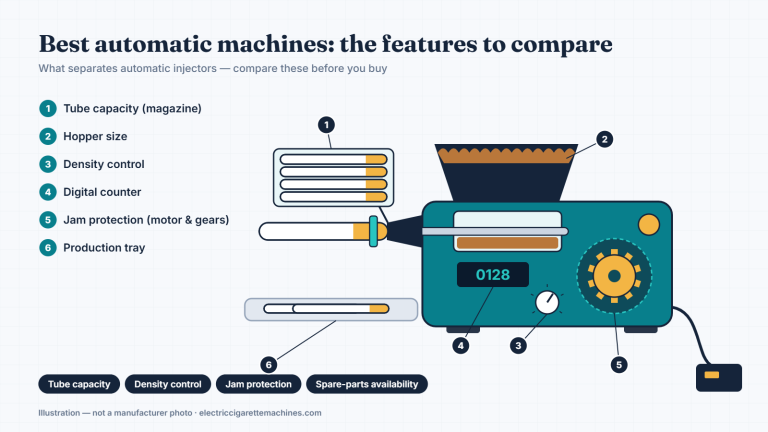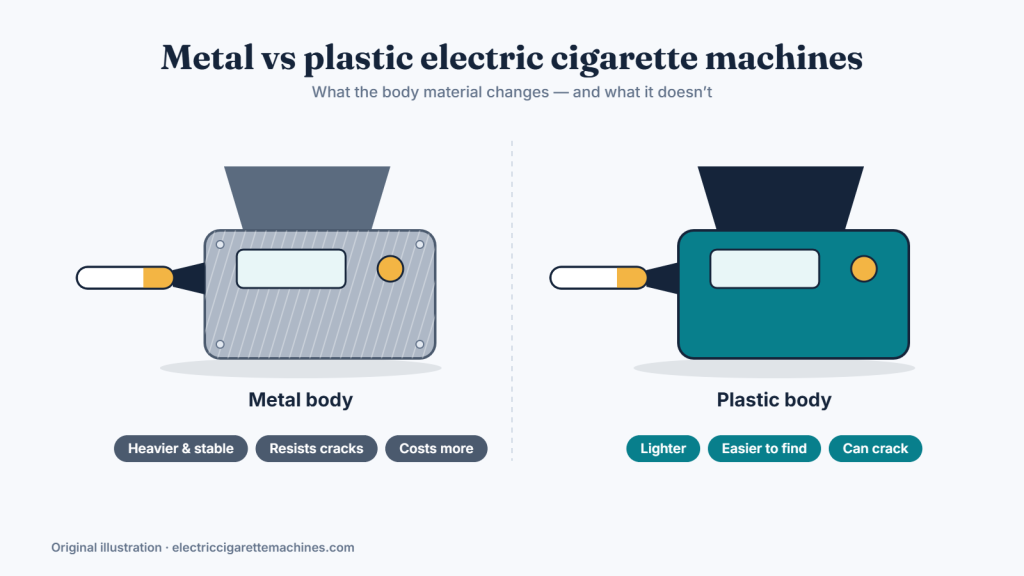
Quick answer: a metal electric cigarette machine is worth it if you roll every day, share the machine with others, or have already cracked a plastic one. A metal body makes the machine heavier, steadier and harder to break — but what decides how well it fills is the parts inside, especially the spoon and the gears. When you shop, check what is actually metal (body, frame, gears or just the trim), not just the word “metal” in the title.
- What “metal” means in a listing
- The metals you’ll see in listings
- Metal vs plastic: side-by-side comparison
- Four myths about metal machines
- Which parts matter most
- Who should buy a metal machine (and who shouldn’t)
- Long-term cost: metal vs plastic
- How to check a “metal” claim on Amazon
- What to look for in a demo video
- Features to compare besides the body
- Caring for a metal machine
- Three buyer scenarios
- Pro tips
- Common mistakes (and fixes)
- FAQ
- Buying checklist
- The bottom line
What “metal” means in a listing
“Metal electric cigarette machine” sounds precise, but sellers use it to describe very different things. Before you compare prices, work out which of these a listing is actually describing:
- Metal body (housing). The outer shell is metal — commonly aluminium, steel or a zinc alloy. This is what most buyers picture.
- Metal frame, plastic shell. A metal chassis inside a plastic cover. Sturdy where it counts, lighter overall.
- Metal internal parts. Metal gears, spoon or nozzle in a plastic body. This often matters more for long-term filling quality than the shell does.
- Metal trim or “metal-look” finish. A plastic body with a brushed or chrome-effect finish. It looks metal in photos but behaves like plastic.
None of these is automatically “better” — they suit different users. The point is to know which you’re paying for. If a listing doesn’t say which parts are metal, assume only what you can confirm from the photos, specifications or the seller’s answers.
The metals you’ll see in listings
When a listing does name a material, it’s usually one of these. Each has a different balance of weight, finish and resistance to marks:
| Material | Typical use in machines | Strengths | Watch out for |
|---|---|---|---|
| Aluminium alloy | Body panels and frames | Light for a metal, doesn’t rust, takes a brushed or anodised finish well | Can dent; anodised finishes can scratch through |
| Stainless steel | Spoons, nozzles, small fittings, some bodies | Hard-wearing, resists corrosion, keeps a smooth edge | Heavier; “stainless” may only apply to one part |
| Zinc alloy (die-cast) | Cast housings, hinges and brackets | Solid, heavy feel; holds detailed shapes | Surface coating can chip if dropped |
| Painted or coated steel | Frames and budget metal bodies | Strong and stable | Can rust where the paint is chipped — keep it dry |
If a listing names a material for the spoon or gears as well as the body, that’s a good sign the seller knows the product well.
Metal vs plastic: side-by-side comparison
Here’s how the body material changes day-to-day ownership. These are general tendencies across the category — individual models vary, so check the specific machine you’re considering.
| Metal body | Plastic body | |
|---|---|---|
| Weight & stability | Heavier; tends to stay put on the counter while the motor runs | Lighter; may need rubber feet or a mat to stop it moving |
| Resistance to drops and cracks | Usually dents rather than cracks | Can crack at corners, hinges and latches |
| Noise and vibration | Extra mass can damp vibration; some metal shells resonate | Can rattle as clips and panels loosen |
| Cleaning | Wipes clean; avoid water near seams and electrics | Wipes clean; can stain or scratch over time |
| Price | Generally higher | Generally lower and more widely available |
| Portability | Less convenient to move or travel with | Easier to store and carry |
| Filling quality | Depends on spoon, chamber and gears — not the shell | Same — depends on the internal parts |
Four myths about metal machines
Myth 1: “Metal machines make better cigarettes.”
Fill quality comes from the spoon, chamber, density setting and your tobacco preparation. A metal body keeps those parts aligned for longer, but it doesn’t change how they fill on day one.
Myth 2: “Metal machines never jam.”
Jams are caused by overfilling, damp or coarse tobacco, and dirty chambers — none of which the body material prevents. Jam protection and regular cleaning matter far more.
Myth 3: “Heavier always means better built.”
Weight is a useful clue when checking a “metal” claim, but a heavy machine can still have plastic gears or a poorly finished spoon. Weight confirms material, not quality.
Myth 4: “A metal machine needs no maintenance.”
Every machine needs brushing after use and a periodic deep clean. Metal bodies also need keeping dry so coatings and painted steel don’t mark or rust.
Which parts matter most
If you can only get some parts in metal, these are the ones worth prioritising, in order of how much they affect the machine’s working life:
| Part | Why it matters | Is metal worth it here? |
|---|---|---|
| Gears / drive | Take the motor’s full force every cycle | Yes — stripped plastic gears are a common end-of-life failure |
| Spoon (injector slide) | Pushes the tobacco; wears with every cigarette | Yes — a metal spoon generally keeps its shape longer |
| Nozzle (tube spout) | Tubes are pushed on and off it constantly | Helpful — a smooth metal tip resists burrs that tear tubes |
| Frame / chassis | Keeps everything aligned | Helpful for heavy daily use |
| Outer shell | Protection, stability, looks | Nice to have — mainly durability and feel |
| Hopper and lid | Holds loose tobacco | Optional — plastic is fine if the hinge is sturdy |
For a deeper look at how each part works and fails, see our cigarette machine spare parts guide.
Who should buy a metal machine (and who shouldn’t)
A metal machine makes sense if you…
- Roll every day or in large batches. More cycles mean more stress on the frame and drive. Our heavy-duty machines page covers high-volume use.
- Share the machine in a household where it gets moved, knocked or rushed.
- Have already cracked a plastic machine at the hinge, latch or body.
- Want a machine that stays put on a smooth counter without a mat.
A plastic machine is probably enough if you…
- Roll occasionally or in small batches.
- Want something light to store in a drawer or take on trips.
- Are trying rolling for the first time and want to keep the starting cost down — our “are rolling machines worth it?” guide runs the numbers, and the cost calculator lets you plug in your own.
Not sure which category you’re in? The Machine Match Quiz takes about a minute and suggests an equipment type based on how you roll.
Long-term cost: metal vs plastic
A metal machine usually costs more upfront, so it’s worth thinking about the whole time you’ll own it rather than the price on day one. The factors that decide which works out cheaper for you:
- How much you roll. The more cycles you run, the more a durable frame and drive pay off.
- How often machines get damaged in your home. One avoided replacement can cover the price difference.
- Whether wear parts are available. A machine you can keep running with an inexpensive spare spoon beats one you have to replace whole.
- Your tube and tobacco costs. These usually dwarf the machine’s cost over a year, whichever body you choose.
Plug your own numbers into our cost calculator to see how equipment, tubes and maintenance add up for your usage.
How to check a “metal” claim on Amazon
Many readers search for metal machines on Amazon directly. Listings vary a lot in how honestly they describe materials, so run through these checks before you buy:
- Read the specifications table, not just the title. Look for a stated material for the body and, ideally, the gears. “Material: Aluminium” or “Alloy” is more meaningful than “metal design” in the title.
- Check the item weight. An all-metal machine should weigh noticeably more than a similar-sized plastic one. A very low listed weight is a sign the “metal” is mostly trim.
- Zoom into every photo. Look at corners, seams and screw points. Moulded plastic usually shows seam lines and rounded edges; metal shows machined edges and visible fasteners.
- Search the reviews and Q&A for “plastic” and “metal”. Owners quickly point out when a “metal” machine turns out to be plastic.
- Confirm tube size and voltage. Make sure it takes your tubes (king size or 100 mm — see our size guide) and suits your mains voltage.
- Check the return policy in case the build doesn’t match the description.
Questions to ask the seller
- Which parts are metal — the body, frame, gears, spoon or nozzle?
- What is the exact material (aluminium, stainless steel, zinc alloy)?
- What does the machine weigh?
- Which tube sizes does it accept, and is the size adjustable?
- Are replacement spoons, nozzles and clips available for this model?
Clear, specific answers are a good sign; vague replies such as “high-quality metal” are not.
🔍 Search shortcuts for metal machines
These open Amazon search results — they are not recommendations of specific products. Verify materials, tube size and voltage on each listing.
| Metal electric cigarette machines | Broad search — then filter by material in the listing details |
|---|---|
| Aluminium-body injectors | Narrows results to listings that name the alloy |
| Stainless steel injectors | Check whether “stainless” applies to the body or only the spoon |
- ✅ Metal electric cigarette machines on Amazon ›
- ✅ Aluminium-body injectors on Amazon ›
- ✅ Stainless steel injectors on Amazon ›
See metal machines on Amazon ›
As an Amazon Associate we may earn from qualifying purchases. We don’t list prices or ratings because they change constantly.
What to look for in a demo video
Watching a machine run before you buy is genuinely useful — especially for judging build quality, which photos hide. When you search YouTube or a listing’s video section, the most informative demos:
- Show a full cycle from start to finish, not a cut-together highlight, so you can see speed and any hesitation.
- Use the same tube size you do — a machine set up for king size won’t behave the same with 100 mm.
- Show the machine being handled — lifted, opened, cleaned. You learn more about the materials from how panels flex and how the lid closes than from any close-up.
- Include the sound. Grinding, clicking or a struggling motor are worth hearing before you own them.
- Come from an owner rather than a seller, ideally after weeks of use rather than straight out of the box.
Once you own a machine, our step-by-step guide to using an electric rolling machine covers setup and technique.
Features to compare besides the body
| Feature | What to check | Why it matters |
|---|---|---|
| Tube size support | King size, 100 mm, or switchable | The wrong size means poor fills and torn tubes |
| Density adjustment | Whether firmness can be set | Lets you match your tobacco and preference |
| Jam protection | Auto-stop or reverse when blocked | Protects the gears — especially important on any machine |
| Hopper capacity | How much tobacco it holds per load | Fewer refills for batch rolling |
| Parts availability | Can you buy a spoon, nozzle and clip for this model? | A durable body is wasted if wear parts can’t be replaced |
| Cleaning access | Does the chamber open easily? | Easy cleaning prevents most jams |
For a ranked overview of machine types, see our automatic cigarette rolling machine guide, the best electric machines page, and our in-depth Powermatic 2 guide.
Caring for a metal machine
Metal machines are tough, but they have their own care needs:
- Keep water away from seams and electrics. Wipe the body with a dry or barely damp cloth; never rinse it.
- Avoid abrasive cleaners and scourers. They scratch brushed finishes and can wear through coatings.
- Brush out tobacco after every session. Fine tobacco dust plus moisture is what leads to sticking and, on some metals, surface marks.
- Lubricate only where the manual says. Oil in the wrong place collects tobacco dust and causes jams.
- Store it somewhere dry, covered if possible, rather than in a damp cupboard.
Our full machine maintenance guide has a cleaning schedule and deep-clean steps, and if a cycle ever stops mid-way, follow the jam-clearing guide before forcing anything.
Three buyer scenarios
These illustrative examples show how the decision plays out. They’re composites of common situations, not individual reviews.
1. The daily batch roller
Someone who rolls a week’s supply in one sitting puts hundreds of cycles through a machine each month. They’ve already replaced a plastic machine whose gears stripped. For them, a metal-bodied machine with metal gears and a readily available spare spoon is the sensible choice — they check the parts are sold separately before ordering.
2. The occasional roller
Someone who rolls a few cigarettes a day and keeps the machine in a drawer doesn’t need the extra weight or cost. A well-reviewed plastic machine with jam protection, plus a cleaning brush, covers their needs.
3. The “metal” listing that wasn’t
A buyer orders a machine titled “premium metal electric injector”. The listed weight seemed low, and when it arrives the body is plastic with a chrome-effect finish. Checking the specifications table and reviews for the word “plastic” before ordering would have flagged it. They return it and choose a listing that names the alloy.
Pro tips
- Put a thin rubber mat under any machine. Even a heavy metal unit is quieter and kinder to your counter on a mat.
- Buy one spare spoon on day one. It’s the part most likely to stop you mid-session, metal body or not.
- Keep the manual with the machine. Lubrication points and tube settings differ between models.
- Log your cleanings and part swaps in our free maintenance tracker to spot wear early.
- Judge build quality in person when you can. Lifting a machine and opening the lid tells you more than any photo.
Common mistakes (and fixes)
- Trusting the title. Fix: confirm the material in the specifications, the weight and the reviews.
- Assuming metal means better fills. Fix: compare the spoon, density adjustment and tube size support too.
- Ignoring parts availability. Fix: check you can buy a spoon, nozzle and clip for the model.
- Buying the wrong tube size. Fix: match the machine to the tubes you actually use.
- Cleaning with water. Fix: dry brush and a barely damp cloth only.
FAQ
Are metal electric cigarette machines better than plastic ones?
They are usually more durable and more stable on the counter, but not automatically better at filling. Fill quality depends mainly on the spoon, chamber and gears. A metal body is worth it for heavy daily use or if plastic machines have cracked on you before.
How can I tell if a cigarette machine is really metal?
Check the specifications for a named material such as aluminium alloy, compare the listed weight with similar plastic machines, zoom into photos for moulded seams versus machined edges, and search reviews and questions for the words metal and plastic.
Do metal cigarette machines last longer?
The body generally survives drops and daily handling better. Overall lifespan still depends on the internal parts and on cleaning — a metal machine with plastic gears can wear out as quickly as a plastic one.
Are metal machines louder?
Not necessarily. The extra weight can reduce vibration, though some thin metal shells resonate. A demo video with sound is the best way to judge a specific model.
Can I find metal electric cigarette machines on Amazon?
Yes. Searching for metal, aluminium or stainless steel electric cigarette machines brings up options, but always confirm in the listing details which parts are actually metal, plus the tube size and voltage.
How do I clean a metal cigarette machine?
Unplug it, brush out tobacco from the hopper, chamber and spoon, and wipe the outside with a dry or barely damp cloth. Keep water away from seams and electrics, and only lubricate where the manual says to.
Buying checklist ✅
- ☐ Decided whether you need metal (daily or heavy use, shared, or past cracks)
- ☐ Confirmed which parts are metal — body, frame, gears or trim
- ☐ Checked the listed weight against similar machines
- ☐ Searched reviews and Q&A for “plastic” and “metal”
- ☐ Confirmed tube size (king size or 100 mm) and voltage
- ☐ Checked that spare spoons, nozzles and clips are available
- ☐ Watched an owner’s full-cycle demo with sound
- ☐ Checked the return policy
Prefer a machine without a motor? Compare with our manual injector guide and the overview of electric cigarette rolling machines.
The bottom line
Choose a metal electric cigarette machine for durability and stability — especially for daily batch rolling or shared use — and verify exactly which parts are metal before you buy. Choose a lighter plastic machine if you roll occasionally or need portability. Either way, fill quality depends on the spoon, the chamber and regular cleaning, so check that spare parts are available and that the machine matches your tube size.